
Why I Write Love That Feels Older Than One Lifetime
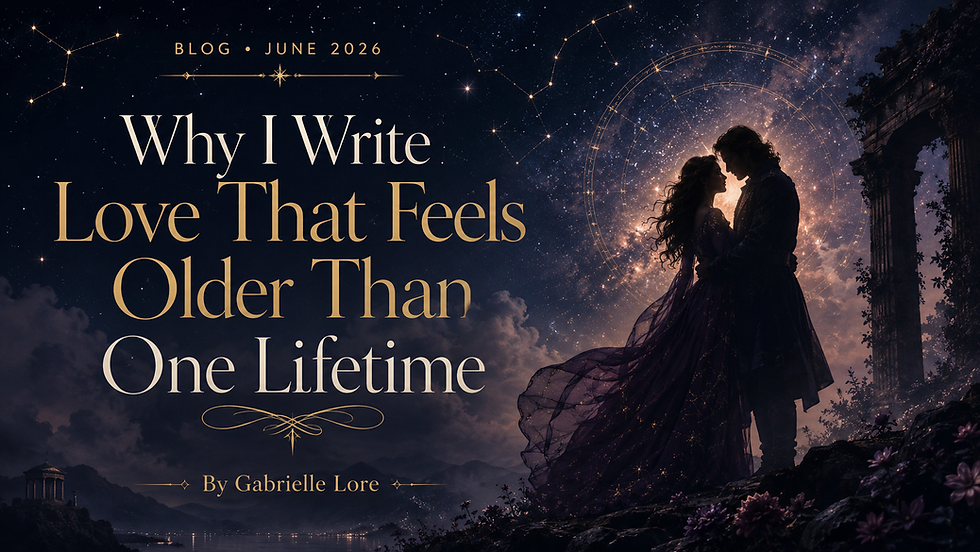
Some love stories begin with a meeting.
Mine often begin with recognition.
Not the simple kind. Not attraction alone. Not the beautiful accident of two people noticing each other across a room.
I mean the deeper recognition.
The strange ache of seeing someone and feeling, before thought, before logic, before safety, that something inside you has moved toward them for longer than this life can explain.
That kind of love appears again and again in my books.
It is in The Mortal Gift, where love is cosmic, soulbound, dangerous, and tied to origins older than Earth itself.
It is in The Chronicles of Eydenia, where love survives across lifetimes, through prophecy, reincarnation, memory, forgetting, and the soul’s refusal to let time have the final word.
It is in Erynweald, where Sterenn and Caelum are drawn together by something neither of them fully understands — grief, hunger, memory, and a bond that feels like a vow returning from the dead.
It is in Final Collision, where love is not gentle at first, but a collision between two wounded people whose darkness recognizes the other before healing has even begun.
It is even there, quietly, in stories that look more human, more contemporary, more rooted in ordinary life: the idea that some loves do not disappear simply because time passes, people leave, letters are lost, summers end, or silence grows too long.
I write love that feels older than one lifetime because I have never been moved by love that is only convenient.
I am moved by love that changes the architecture of a soul.
Love that terrifies because it reveals too much.
Love that awakens what someone tried to bury.
Love that does not arrive to make life easier, but to make the truth impossible to avoid.
In my stories, love is rarely simple.
It is not always safe at first.
It is not always soft.
It is not always ready.
It is not always free of shadow.
But it is meaningful.
The love I write often comes with memory attached. It carries grief, longing, unfinished vows, past mistakes, old wounds, guilt, devotion, and the painful beauty of being seen by someone who reaches the places you thought were hidden forever.
Maybe that is why I return so often to themes of reincarnation, soulmates, ancient bonds, and impossible recognition.
Because those themes allow me to explore a question that has always haunted me:
What if love does not begin when we think it begins?
What if some connections are not created, but remembered?
In fiction, this kind of love becomes magical.
It becomes prophecy.
It becomes soul memory.
It becomes a curse, a bond, a vow, a past life, a dream, a song, a face glimpsed in another century.
But beneath the fantasy, the feeling is deeply human.
Many people know what it is to feel marked by someone.
To meet a person who changes the direction of their inner life. To love someone they cannot easily explain. To carry an attachment that time does not erase in a clean, obedient way. To feel that certain relationships arrive not to decorate life, but to transform it.
That transformation is what interests me.
Not perfect romance.
Not love as an escape.
Love as awakening.
Love as mirror.
Love as wound.
Love as fire.
Love as memory.
Love as the force that asks: who are you beneath everything you learned to become in order to survive?
This is why my heroes are often haunted.
They do not enter love untouched. They bring centuries, secrets, violence, shame, exile, grief, or emotional numbness. They are not saved by love in a simple way. They are confronted by it.
And my heroines are not passive recipients of devotion.
They are often wounded, powerful, afraid, intuitive, grieving, or awakening to a truth that will demand everything from them. Love does not complete them by making them smaller. It calls them back into their own power.
That matters to me.
Because the strongest love stories are not about two incomplete halves becoming one whole.
They are about two souls standing before each other with all their fractures visible and discovering that recognition does not erase the work — it begins it.
Love older than one lifetime is not easy love.
It carries responsibility.
If a bond has followed you through time, then it has also carried what was unresolved: the wound, the betrayal, the silence, the death, the promise, the choice that was never completed.
This is why soul-deep love in my books is often both beautiful and painful.
It does not only say, “I have found you.”
It asks, “What will you do differently this time?”
That question is where the story lives.
Will they repeat the wound?
Will they run?
Will they choose fear again?
Will they remember too late?
Will they learn to love without destroying each other?
Or will they finally become brave enough to meet what time has been trying to return to them?
I think this is why readers are drawn to love that feels ancient.
Because it gives language to a longing many of us carry: the hope that some bonds matter beyond the ordinary rules of time, that love can survive distance, death, forgetting, silence, and even the versions of ourselves that did not yet know how to choose it well.
Maybe that is fantasy.
Maybe it is memory.
Maybe it is simply the human heart refusing to accept that what is sacred can vanish so easily.
I do not know.
But I know that when I write this kind of love, I am not writing perfection.
I am writing recognition.
The trembling moment when two souls stand close enough for the past to wake.
The ache of remembering without understanding.
The fear of being changed.
The impossible hope that this time, love might not end in ruin.
Because some love stories are not born.
They return.
And when they do, they do not ask only to be felt.
They ask to be remembered.


Comments